Danderyd Hospital
Handling the UndeadDanderyd Hospital is the first major medical centre to confront the return of the dead at scale, and the place where the crisis is seen both as a public emergency and as an intimate family catastrophe. Its wards fill faster than staff and equipment can adapt; at the same time, Eva Zetterberg’s presence there unsettles the distinction between a body declared dead and a person who can still speak, answer, and be recognized by those who love her.
Emergency centre in the first night
The hospital enters the crisis through two converging emergencies. David Zetterberg receives a physician’s call from Danderyd Hospital and is so overwhelmed by its news that he sinks to the floor and throws down the phone. On the drive there, the electronic traffic systems are out and the lights flash yellow. At the hospital entrance he refuses Leo’s offer to accompany him, then makes his way through corridors where the lamps above the doors blink and an alarm sounds continuously. Eva, who collided with an elk, has died before David can reach her: her heart stops at 22:36.
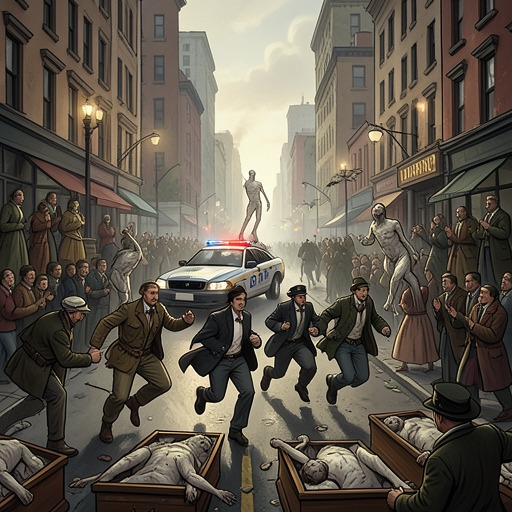
The hospital’s staff are already facing a different kind of emergency. After the electrical disturbance leaves everything switched on but malfunctioning, staff report that bodies in the hospital are escaping. Security guards initially treat the calls as a joke; reinforcements are sent down, then doctors and emergency surgeons, as reports multiply that the dead have awakened. Ludvig calls Gustav Mahler from Danderyd with the news that bodies are getting up, estimating that at least a hundred corpses may be involved. At 23:40, the infectious diseases ward is designated a temporary gathering place and extra staff are urgently summoned.
Eva’s death and awakening
The hospital is also where the novel makes the crisis physically immediate for David. At Eva’s bedside, the doctor confirms that her heart is no longer beating. Yet Eva is not simply absent: she pulls at the rubber tubing, and the doctor observes that she does not seem to require it. The clinical fact of a stopped heart therefore fails to settle the question of what she is. David’s fear and grief gather around details the medical description cannot resolve, especially her altered eye and the troubling gap between a familiar face and the person—or presence—looking back at him.
The moment does not become a spectacle for long. By the time Lasse arrives, Eva’s awakening no longer seems sensational. The hospital’s ordinary procedures continue around an event for which they have no settled explanation, and its later records preserve that tension. In his first interview, conducted after her transfer to Solna, Tomas Berggren notes the short interval between the cessation of Eva’s life-sustaining functions and her awakening without that support. Her ability to speak is improving, but her words also disclose fear and an inability to use her mouth as expected. The examination records observable change without making her experience fully legible.
A centre for containment and study
As reports arrive from across the city, Danderyd becomes a logistical centre as well as a hospital. The first reported non-awakenings help establish a limit to the phenomenon: two bodies, dead for ten and twelve weeks, do not return, and both had repeatedly been treated with formaldehyde while funeral arrangements were pending. Further reports suggest that only people dead for two months or less have awakened. The hospital is thus a place where cases are counted and compared, even while the scale of events exceeds the capacity to investigate them carefully.
The pressure rises sharply. By 01:00, 430 returned dead have been admitted to the infectious diseases clinic, and staff are clearing wards to make room. Only two ambulances at each hospital are reserved for emergency calls; the rest are being used for transport. Since Danderyd cannot hold everyone, taxis are called to carry patients to other hospitals. At 02:30, people considered especially important to understanding the phenomenon are moved to the Medical Examiner’s office at Karolinska Institute in Solna. Eva is among them, as is Rudolf Albin, who had been dead longer before awakening than anyone else identified so far. Danderyd’s role changes from receiving the returned dead to sorting, documenting, and transferring them.
Staff, visitors, and the strain of proximity
The hospital’s crisis is not only a question of beds and transport. Reports describe a chaotic night in which cooperation between staff becomes impossible on some wards; workers are reassigned in an effort to prevent further conflicts. Staff members attribute some disputes to an apparent ability to read one another’s thoughts, while military sources report phenomena arising through direct contact with large gatherings of the returned dead. The hospital is therefore both a workplace under extreme pressure and a setting in which proximity itself seems to alter what people experience.
The scale continues to grow. In a later interview, the head of Danderyd reports 1,962 returned dead at the hospital, with more potentially arriving even as the interview takes place. Families gather outside, but visitors are not yet permitted: officials say the patients are isolated and receiving care, while admitting that no one knows when entry will be safe. That promise of eventual access sits uneasily beside the accounts of exhaustion. Nurse Vera Martinez explains that staff cannot sustain the effort of managing their own thoughts and feelings in rooms full of the dead. Metronomes brought in to calm the wards work for only a day before the patients take them apart; staff replace them with more durable moving devices. A modest experiment in soothing the ward becomes another measure of how quickly familiar tools fail.
A hospital room after the emergency
Danderyd remains important beyond the first rush of admissions because it is also the setting for a later visit by David and Magnus to Eva. The room is sparse: a bed, a nightstand with a machine, an armchair, and medical cables running from Eva’s head. Thick gauze covers the damage to half her face. One eye looks almost healthy, while her face has lost weight and her smile resembles a grimace. These concrete changes make recovery difficult to name as a straightforward return to health.
David finds that Eva answers questions sensibly but mechanically, as if repeating learned behaviour. He notices changes on the EEG screen, with the bubbles on its lines growing slightly larger and closer together, but the measurement does not settle what her responses mean. Roy acknowledges progress without finishing his reassurance, then asks whether the Fisher means anything to her. The scene leaves the hospital at the edge of several forms of knowledge: instruments register activity, clinicians assess progress, and family members listen for the person they remember.
Danderyd Hospital’s narrative significance lies in this repeated collision between institutional order and what resists it. It classifies patients, assigns wards, arranges transport, restricts visitors, and tests possible means of calming the returned dead. Yet none of those actions can make the central uncertainty disappear. At Eva’s bedside, the stopped heart, the functioning body, the improving speech, and the mechanically delivered answers remain distinct facts rather than a single reassuring diagnosis.